


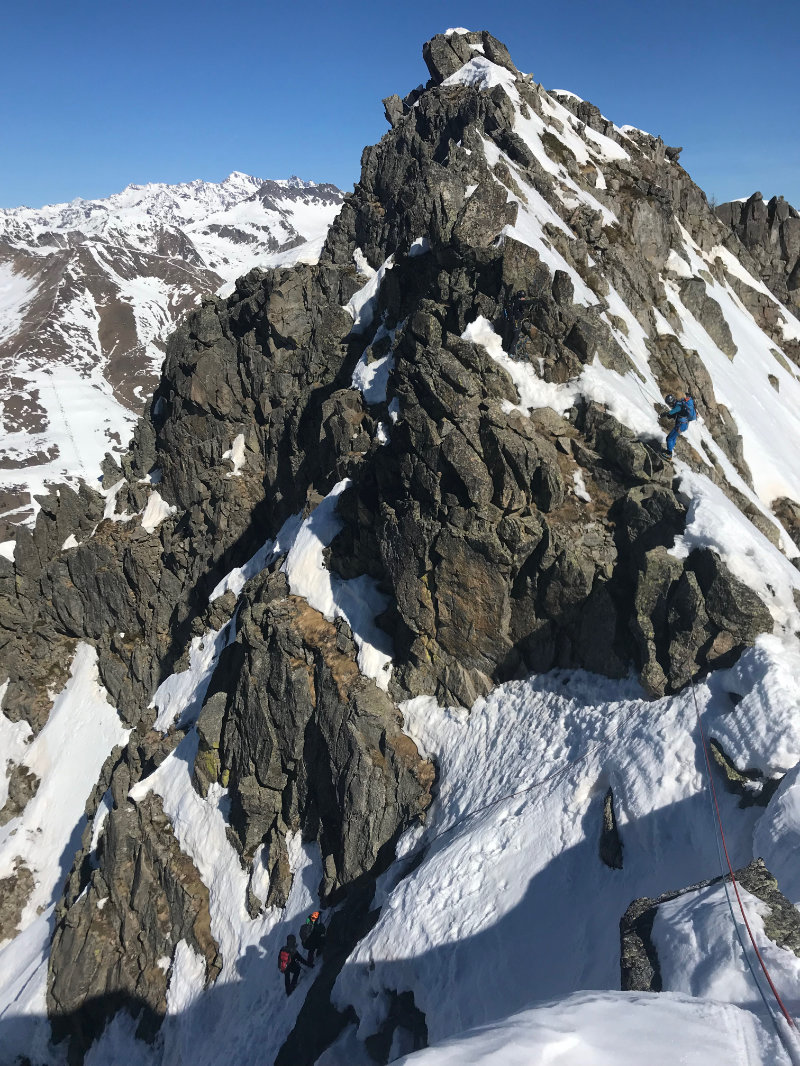
When people talk about mixed climbing in the Tonale area, they are usually referring to the long, jagged ridge which rises from the Passo del Paradiso (at the top of the first section of the cable car) and separates the Val Presena from the Tonale basin. There are three peaks along the ridge line: Monticello, Monticello di Mezzo (2,539 m) and Monticello Superiore (2,609 m), with the Diavolo Couloir separating the lower peak from the upper one.
Until about ten years ago, these minor peaks were not particularly popular with mountaineers. And indeed, when compared to the Busazza or the Corno di Lagoscuro, they do not stand out. Then, almost by chance, it was discovered that they can offer some very respectable climbs, all sharing one very important feature: ease of access. Let’s face it, even we mountaineers – who are more prone to masochism than most – sometimes fancy sleeping in on a Sunday morning until at least dawn; well, when climbing ‘the great faces’, that’s simply not possible.
Here is an account by Francesco Salvaterra, a Mountime guide, of a day’s climbing at Monticello Superiore.
Wake up in good time depending on your route by car – if you’re travelling via Val di Sole, don’t miss a Sicilian cannolo at the Casa del Marzapane in Pellizzano. At 8.30 am, the Paradiso ticket office opens; take the lift up to the first section. Descend on the side of the piste wearing crampons, and in 10–15 minutes you’ll reach the start of the routes; skis and snowshoes aren’t needed, and the tracks are always very easy to follow. The climbing ranges from moderate to advanced difficulty up to the ridge line, after which there’s a short abseil down the opposite side, followed by a walk that’s exposed in places and tiring if the snow is deep, to get back to the lift. What do you reckon?!
Following the earliest explorations dating back to the First World War (if not earlier) and a brief visit by Pericle Sacchi to the Monticello di Mezzo area, subsequent mountaineering activity took on a ‘modern’ character, led primarily by Massimo Faletti and Mauro Mabboni. We are talking about just a few years ago; although, in terms of numbers, the area really ‘exploded’ with the Mafia Bianca route, which saw hundreds of repeats in a single winter. Also in the area, Max Faletti and Cain Olsen have opened several trad routes on rock for the summer season.
But let’s go into a bit more detail… here’s some useful information about the Monticelli face and one of its most popular and frequently climbed routes.
Access to Monticello Superiore
The Monticelli face lies to the west of the Paradiso run; head down the run and keep to the right. You can walk up from the bottom (about an hour if you stay alongside the run) or, more conveniently, take the first section of the ascent, then walk down the Paradiso run and climb up the alluvial fan leading to the start of the route (about twenty minutes).
Rientro
Su tutte le vie si può scendere a corde doppie ma è decisamente preferibile raggiungere la cresta sommitale e scendere sul versante opposto. In questo modo ci si toglie prima dall’ambiente a rischio (è sempre una buona regola), si è più veloci, si evita di congestionare la salita e si fa un anello potendo approfittare della funivia anche in discesa.
Mafia Bianca, a route by chance.
There are routes whose line and preparation are carefully planned, and others that come about by chance. This is the case with Mafia Bianca. On that day, 25 November 2018, Rossana Tomasi, Alessio Tait and I headed to Tonale to repeat the Pernice route. The idea was to shake off a bit of rust from our ice axes without struggling too much on the approach, and the M6+ grade reported by the first ascenders seemed a guarantee of a challenging climb. We’d decided to walk up rather than take the cable car, and because of me, we went too far, passing the start of the route. I was convinced that the couloir was the right one, but after a stretch of climbing without finding any anchors and with no match to the route description, we realised we were completely off course.
Never mind; with one pleasant pitch after another, we reached the ridge line, cutting through the substantial snow cornice built up by the southerly wind. We had very little gear to leave behind to set up the abseils, but fortunately, as we scraped away at the snow, we found rocks and protrusions wedged here and there, which allowed us a quick descent back to the piste. I must say that initially we hadn’t been too keen on the route; we’d been looking for something more challenging that day, but it was precisely the ‘good-natured’ nature of the outing that made me think it would prove very popular… though I never imagined it would attract such a crowd! In the years that followed, I happened to return there several times, and it’s probably the route I’ve repeated the most times of all to date. To get an idea of just how popular the route is, you only need to take a look at the rock on the crux of the overhanging chimney. It’s so scarred by crampons that it looks like a section of the Hornli Ridge on the Matterhorn. ‘Mafia Bianca’ is a route to get you started using ice axes and crampons on mixed terrain; a transitional route, with a crag-style approach but the atmosphere and length of a high-mountain route. Some have asked about the name… ‘Mafia Bianca’ is a fine film by Luigi Zampa, but it’s also the mafia without any murders (quote: Raffaele Cantone).
Here is the report on the classic route: Mafia Bianca.
Passo del Tonale, 200 m, 70°, M4+ – Francesco Salvaterra, Alessio Tait, Rossana Tomasi – 25 November 2018.
A fun and rewarding climb of moderate difficulty, which has quickly become a classic with hundreds of ascents. Although it lies above the Paradiso ski run, the atmosphere is truly alpine and you hardly ever see the run because the route is tucked away in a side couloir. The real highlight of this route is its very easy access; it can be climbed even in less than ideal conditions with plenty of exposed rock and powdery snow, though you’ll often find packed snow or even ice. There is one crucial section: the crux, a vertical dihedral to be negotiated in a straddle position, protected by slings on wedged rocks. You climb up to a shoulder; from here, a small mixed-terrain dihedral leads to another gully, which you follow via two steep jumps up to the summit ridge. The route was originally opened with minimal traditional gear; subsequently, all belay stations have been equipped with two 10mm stainless steel bolts. On the pitches, there are a few slings threaded through wedged rocks. Bring friends and stoppers; it is rare to find ice for ice screws, but it can happen.