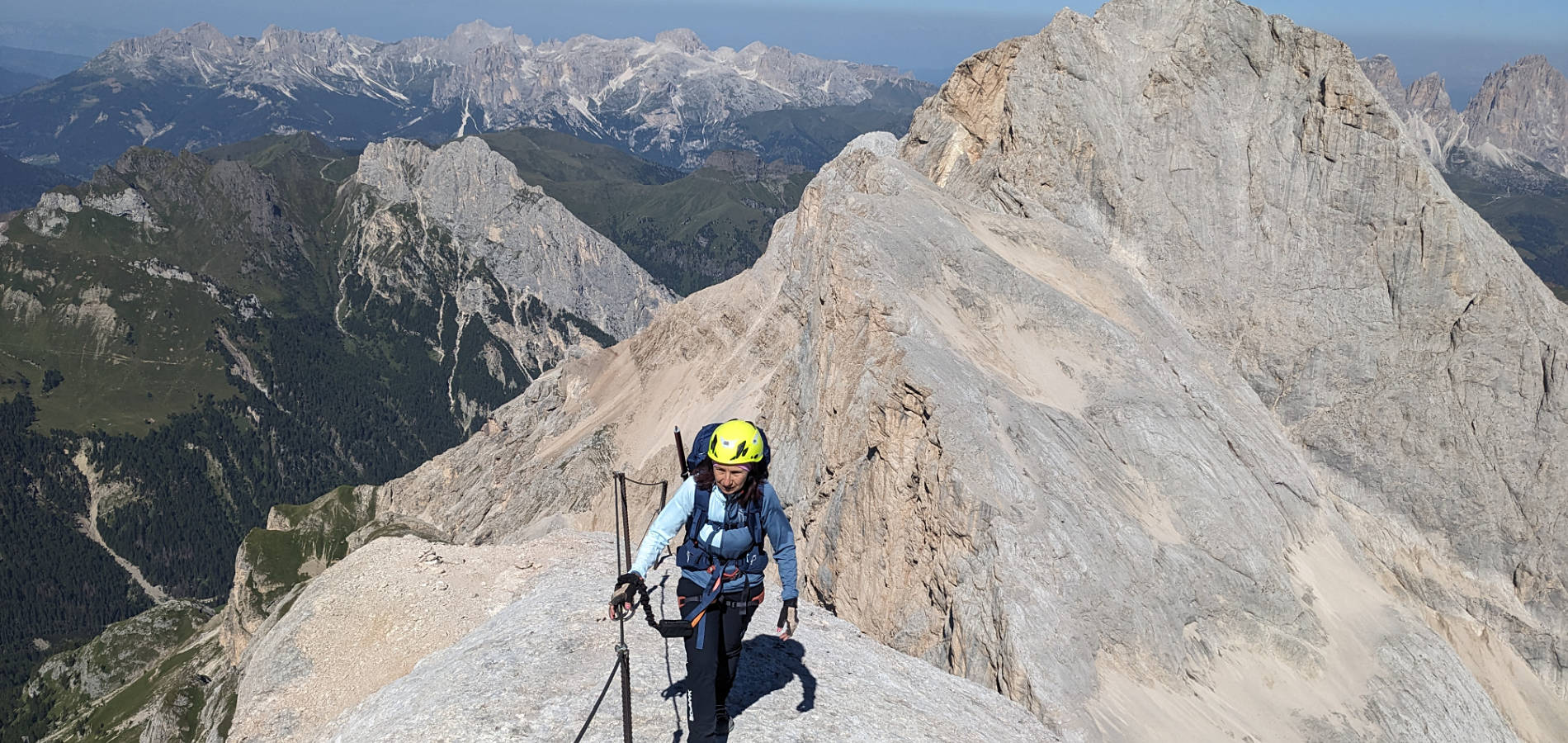
The Marmolada via ferrata, along the West Ridge, is a route of great technical and scenic merit.
A fascinating route that allows you to explore a wide variety of terrain: as well as the via ferrata running along the western ridge of the Marmolada, mountaineers will have to cross the Vernel Glacier and tackle the heights of the ‘Queen of the Dolomites’. A challenging route that offers a sense of achievement, thrills and magnificent views.
Much of the difficulty of the Marmolada via ferrata depends on the snow and ice conditions: if the steel cable along the ridge is not covered in snow and the rock is clear, the via ferrata does not present any particular difficulties. There are, however, some challenging sections that require caution, notably the crossing of the Vernel Glacier, both on the ascent and descent, not least due to the presence of crevasses. The professionalism and expertise of a mountain guide by your side will ensure your safety both whilst crossing the glacier and during the via ferrata section.
For this ascent, the route normally starts from the Fedaia Pass at an altitude of 2,057 m. After just over an hour and a half’s walk, you reach Pian dei Fiacconi, where the former mountain hut once stood at an altitude of 2,650 m. From here, you head westwards until you reach the Vernel Glacier. Once crampons are fitted, you ascend the glacier – which has few crevasses – towards Forcella Marmolada. Once past the glacier’s terminus, an initial section of steel cable makes it easier to reach the saddle separating the Marmolada from the Piccolo Vernel. This is where the actual via ferrata begins, following the west ridge as it winds its way along sloping slabs and dihedrals, offering breathtaking views of the Grande and Piccolo Vernel throughout. In the final section, the route stays close to the ridge, allowing you to look out over the opposite slope and take in the vertiginous south-facing walls and the Val Contrin below.
Once you’ve reached the summit at 3,343 m, a beer at Capanna Punta Penia is a must before tackling the descent.
Costi condizioni materiali
La quota comprende
With you, a UIAGM-certified Mountain Guide: preparation, safety and technical support at every stage of the activity.
Technical equipment: helmet, harness, via ferrata kit and crampons.
La quota non comprende
Anything not expressly stated is included in the price.
Materiali
Suitable clothing, preferably in layers, a waterproof jacket, a hat and gloves
Hiking boots (preferably those compatible with crampons)